Works
See Google Scholar for complete list.
2026
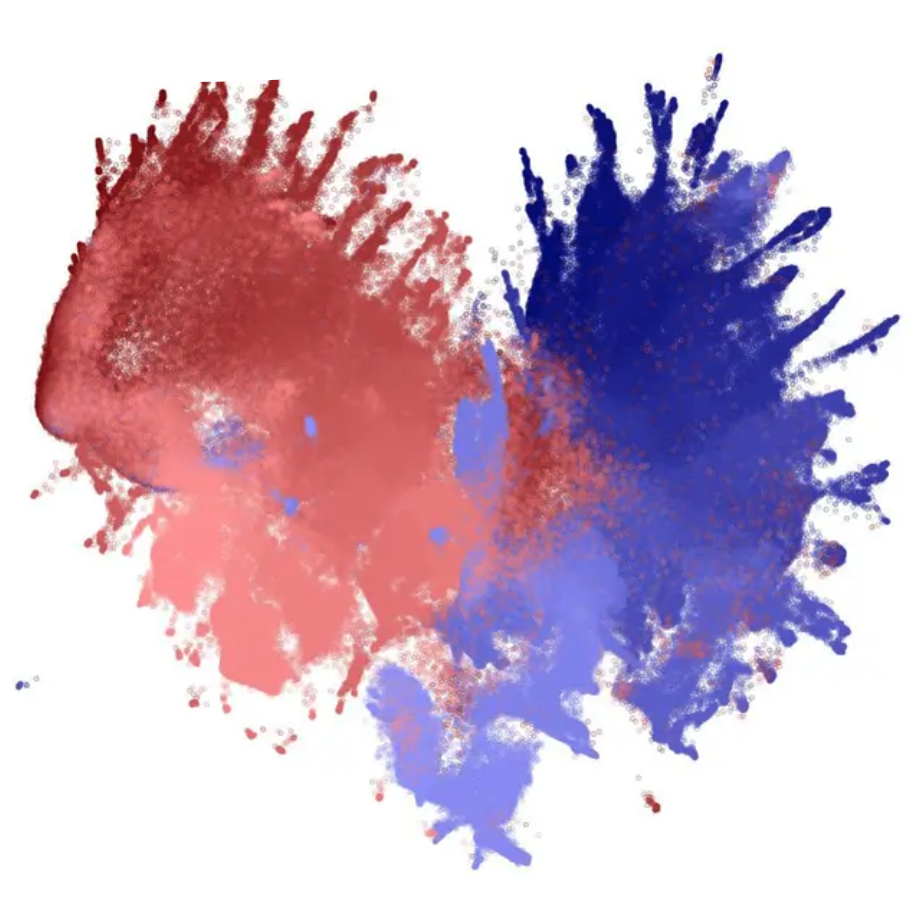
- Visualizing LLM Latent Space Geometry Through Dimensionality ReductionAlex Ning, Vainateya Rangaraju, and Yen-Ling KuoIn ICLR Blogposts 2026, 2026
In this blog post, we extract, process, and visualize latent state geometries in Transformer-based language models through dimensionality reduction to build a better intuition of their internal dynamics. We demonstrate experiments with GPT-2 and LLaMa models, uncovering interesting geometric patterns in their latent spaces. Notably, we identify a clear separation between attention and MLP component outputs across intermediate layers, a pattern not documented in prior work to our knowledge.
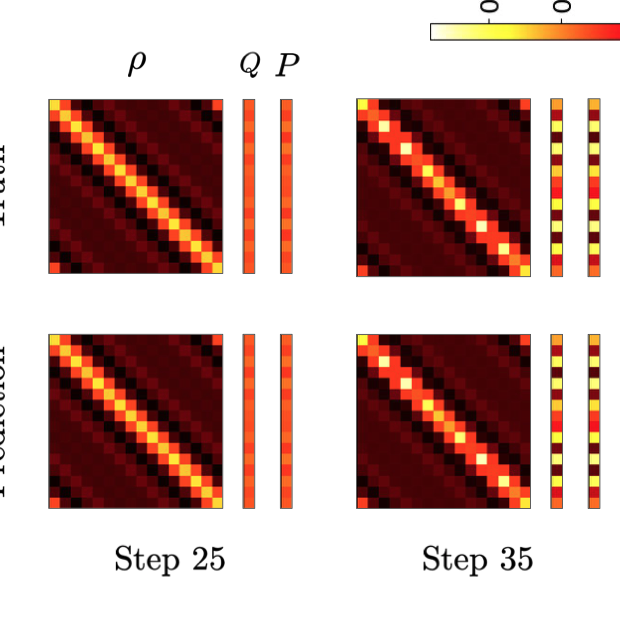
- Recurrent convolutional neural networks for modeling nonadiabatic dynamics of quantum-classical systemsAlex Ning, Lingyu Yang, and Gia-Wei ChernPhys. Rev. E, Jan 2026
Recurrent neural networks (RNNs) have recently been extensively applied to model the time evolution in fluid dynamics, weather predictions, and even chaotic systems due to their ability to capture temporal dependencies and sequential patterns in data. Here we present an RNN model based on convolutional neural networks for modeling the nonlinear nonadiabatic dynamics of hybrid quantum-classical systems. The dynamical evolution of the hybrid systems is governed by equations of motion for classical degrees of freedom and von Neumann equation for electrons. The Physics-Aware Recurrent Convolution (PARC) neural network structure incorporates a differentiator-integrator architecture that inductively models the spatiotemporal dynamics of generic physical systems. We apply our RNN approach to learn the space-time evolution of a one-dimensional semiclassical Holstein model after an interaction quench. For shallow quenches (small changes in electron-lattice coupling), the deterministic dynamics can be accurately captured using a single-CNN-based recurrent network. In contrast, deep quenches induce chaotic evolution, making long-term trajectory prediction significantly more challenging. Nonetheless, we demonstrate that the PARC-CNN architecture can effectively learn the statistical climate of the Holstein model under deep-quench conditions.
2025
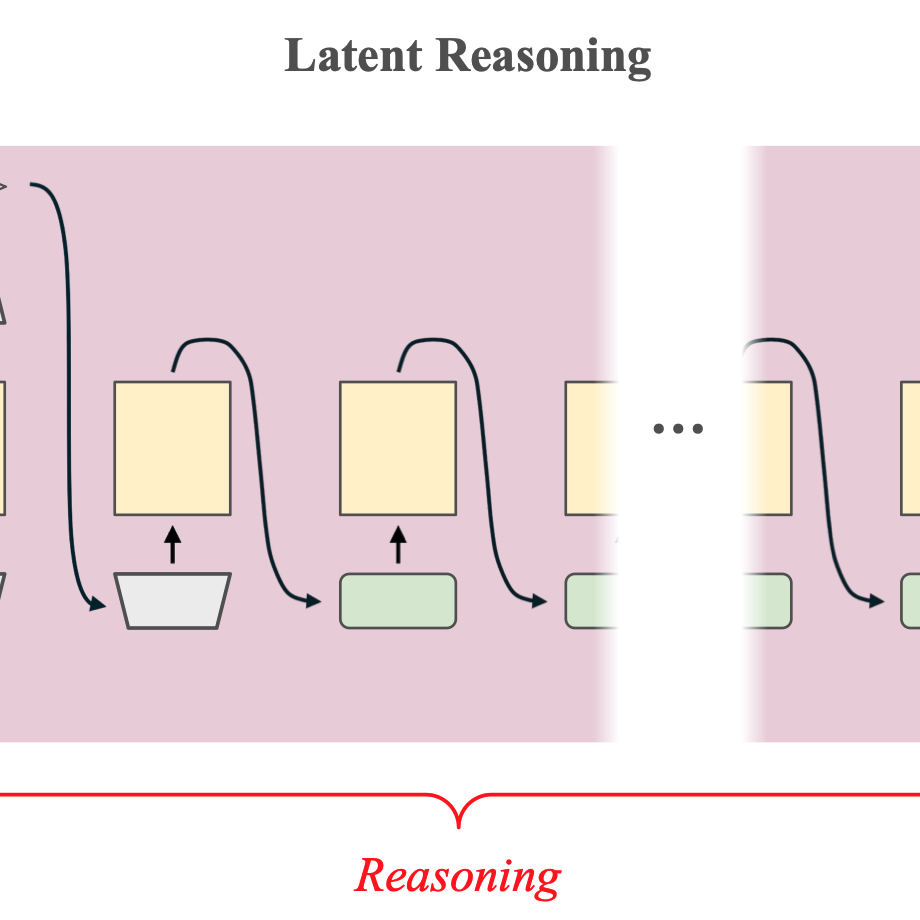
- Learning When to Stop: Adaptive Latent Reasoning via Reinforcement LearningAlex Ning, Yen-Ling Kuo, and Gabe Gomes2025
Latent reasoning represents a new development in Transformer language models that has shown potential in compressing reasoning lengths compared to chain-of-thought reasoning. By directly passing the information-rich previous final latent state into the next sequence, latent reasoning removes the restriction to human language tokens as the medium for reasoning. We develop adaptive-length latent reasoning models and introduce a post-SFT reinforcement-learning methodology to optimize latent reasoning length by minimizing reasoning length while maintaining accuracy. This, in turn, further reduces compute usage and raises the bar on the compressive capabilities of latent reasoning models. Experiments on the Llama 3.2 1B model and the GSM8K-Aug dataset show a 52% drop in total reasoning length with no penalty to accuracy. In future work, we plan to extend to additional models and datasets, analyze relationships between training coefficients, experiment with architecture variations, and continue our knowledge distillation for latent reasoning SFT efforts. We make our code and pretrained weights available at https://github.com/apning/adaptive-latent-reasoning.
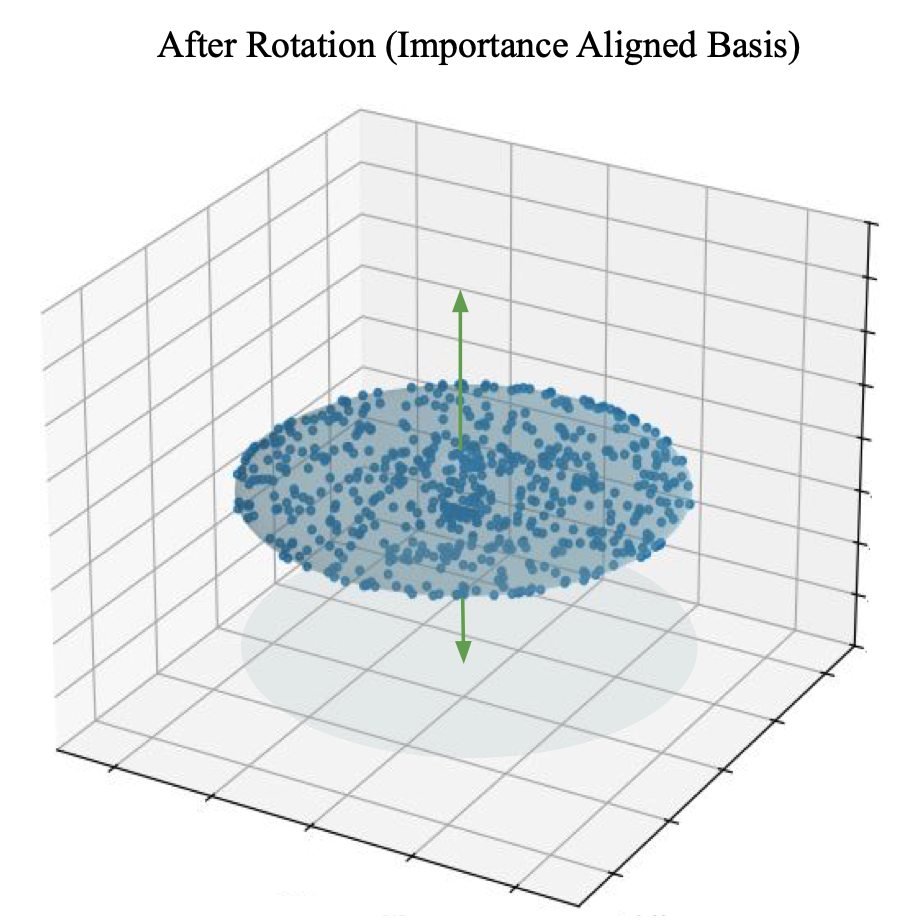
- Change-of-Basis Pruning via Rotational InvarianceAlex Ning and Vainateya Rangaraju2025
Structured pruning removes entire neurons or channels, but its effectiveness depends on how importance is distributed across the representation space. Change-of-basis (CoB) pruning addresses this challenge by applying orthogonal linear transformations that concentrate importance within certain dimensions. However, many standard deep learning architectures are not inherently invariant to such transformations. To enable compatibility, we introduce two-subspace radial activations (TSRAs): an activation family that is invariant to orthogonal linear transformations applied independently within its two activation subspaces. This invariance allows CoB transformations to be merged into surrounding weights without incurring extra parameters. We position this work as a proof-of-concept that a rotationally invariant design may offer a principled approach towards change-of-basis pruning. We do not provide an analysis of multiple TSRA candidates nor do we explore weight initialization for any TSRAs. These limitations, combined with other necessary modifications we make to permit rotational invariance, result in a slight accuracy drop of 4.52% compared to a ReLU-based control. However, using activation-magnitude importance, VGG-16 implementing our CoB+TSRA framework shows encouraging results on CIFAR-10. Under fixed-ratio structured pruning, CoB improves accuracy over a TSRA baseline at all pruning ratios and extends reliable pruning frontier from roughly 30% to 70% of parameters without post-prune fine tuning. Under threshold-based pruning strategies, CoB prunes 90−96% of parameters while maintaining 1−6% accuracy drop after fine-tuning. Together, these results indicate that rotationally invariant architectures may offer a promising path towards CoB pruning.